Leadership Isn't Personal · Chapter 9
The Intervention
Timing Matrix
Every deviation you see in the work is answered by two questions: how early did you catch it, and how hard did you push when you did? The combination produces four very different kinds of leadership — only one of which builds autonomy. The other three damage trust, teach the wrong lesson, or simply don't work.
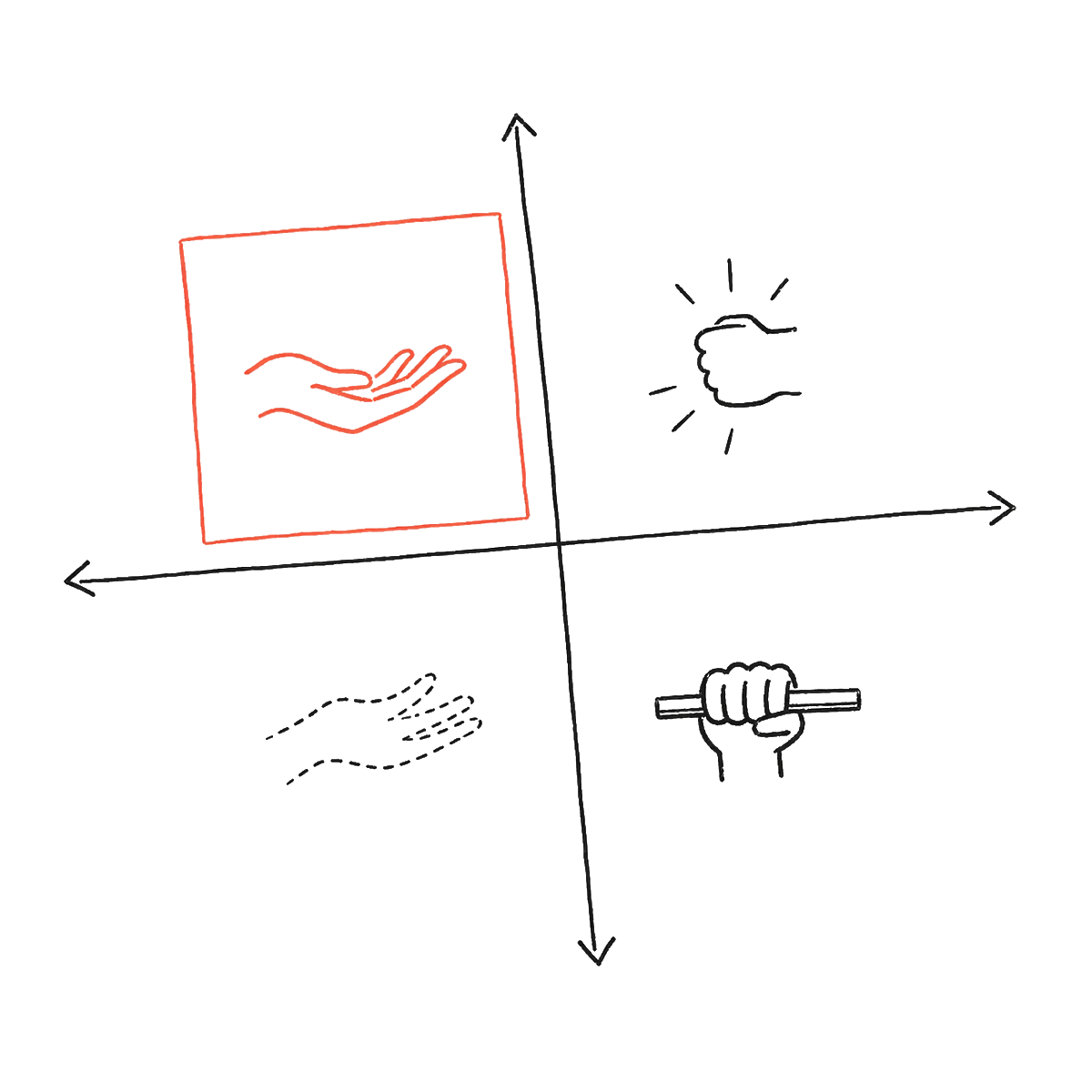
Vertical axis
Timing — top is Early, bottom is Late.
Horizontal axis
Pressure — left is Light, right is Heavy.
Coral square
The only quadrant that builds the next leader.
Early · Light
Guidance
A quiet word at the right moment. Preserves autonomy. The person stays in control of their own correction.
Early · Heavy
Overcorrection
You saw it early and brought a hammer. Kills initiative. People stop surfacing small things because they get big reactions.
Late · Light
Insufficient
A soft touch on an issue that's already spread. Feels diplomatic. Solves nothing. The signal is "this doesn't matter enough."
Late · Heavy
Enforcement
The correction you're forced into when you missed the window. Sometimes necessary. Always expensive. Always visible.
The Signal vs. Noise Filter
Before you intervene, run these four questions.
Not every deviation needs a response. Light intervention on noise trains your team to second-guess themselves. Heavy intervention on repeat deviations is where trust goes to die. Use this filter to decide whether you're looking at signal worth intervening on — or noise worth letting pass.
1
Does it repeat?
Same deviation, same person or same team, more than once in a rolling window. Once is a data point. Twice is a pattern. Three times is a standard.
2
Does it spread?
Is the deviation showing up on other teams, other groups, other projects? A single-pocket oddity is usually noise. Distribution means the system is sending the same signal everywhere.
3
Does it compound?
Does letting it slide make the next deviation easier? Does it make the recovery more expensive? Some misses are self-contained. Others are on-ramps.
4
Does it redefine normal?
If you don't address it, will people stop flagging this category of miss entirely? That's the most dangerous answer, because you'll stop hearing about it.
The rule of thumb
Zero Yes answers: let it go. You'll intervene on the real signal when it comes. One Yes: watch it. Note it. Don't act yet. Two or more Yes answers: intervene now, while it's still early and you can still be light. That's the coral quadrant. That's the only place autonomy survives.